BUYER'S GUIDE
Porsche Macan Turbo Electric: UK Buyer's Guide
Range, charging, specification and the checks before you buy.
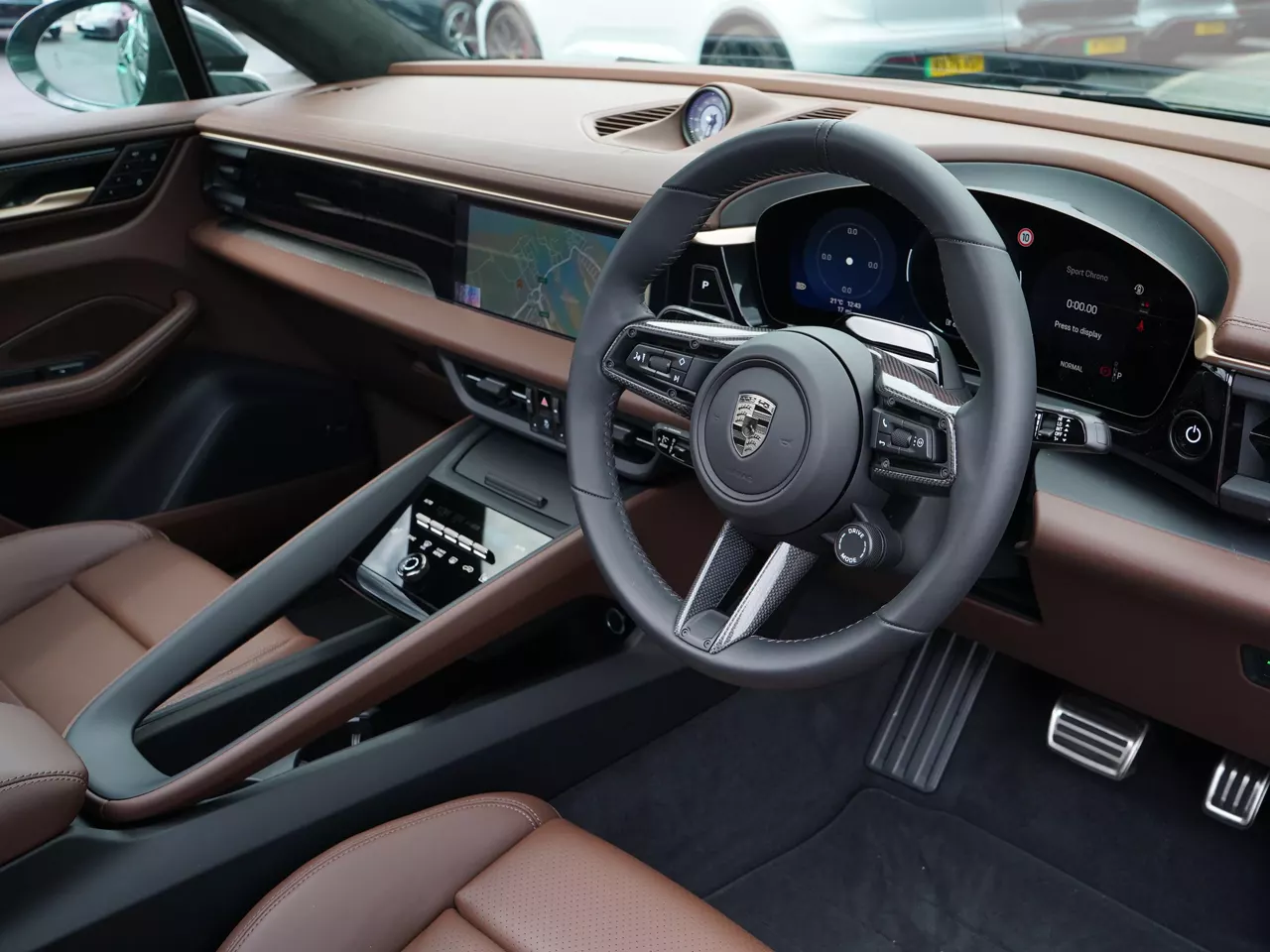
The right-hand-drive cockpit in Truffle Brown leather.
These answers are for a UK buyer of a Macan Turbo Electric, not for one photographed car. Where a figure comes from the saved advert or the separate configuration, it is labelled and linked to a documented specification example.
Buyer FAQs
Is this Macan Turbo electric, and how does it differ from the older petrol Turbo?
On the Oak Green example (advert 6GPVMD, captured 17 October 2026) Yes. The Oak Green example is a battery-electric Macan Turbo, with a permanent-magnet motor on each axle (Advert p.9). Turbo names the model. It does not mean this car has a petrol turbocharger, and it is not a hybrid.
The earlier petrol Macan Turbo is the previous generation, with a combustion engine and a PDK gearbox (Porsche, petrol Macan Turbo, 2019). The change a buyer feels is from filling a tank to planning a charge. Battery condition, and the charger the car can actually use, sit alongside the usual checks of history, condition and specification.
What real-world range should I plan for?
On the Oak Green example (advert 6GPVMD, captured 17 October 2026) Plan from the route and from consumption you have already seen. Do not treat 341 miles as a winter motorway promise.
On the Oak Green example (advert 6GPVMD, captured 17 October 2026) The 2026 advert states 341 miles WLTP combined (Advert p.25, and again in the summary on Advert p.3). The separate 2027 configuration states 337 miles (Config p.12). Those are two documents. Neither is a controlled UK motorway test, or a winter test, of this 22-inch car. Higher speed, cold or hot weather, cabin heating and a heavier load can all shorten the distance (Porsche UK, what changes electric range). Use the car’s own route planning, and leave a reserve.
On the Oak Green example (advert 6GPVMD, captured 17 October 2026) The archived advert’s charging table states 100.0 kWh gross (Advert p.26). The table does not give a usable-capacity figure. Separately, Porsche’s model-level launch notes describe roughly 95 kWh usable on the electric Macan (Porsche, launch notes on the Macan battery). The Oak Green specification guide uses that same general model figure; neither source measures this individual car’s current usable capacity. Using that figure only as arithmetic, 95 kWh from 80 per cent down to 10 per cent is 66.5 kWh. At an assumed 2.5 miles per kWh that is about 166 miles. At an assumed 3.0 miles per kWh it is about 200 miles. These illustrative calculations are not a winter result, a summer result, or a test of this car. Replace the assumed figure with what the car uses on your own roads, and allow for the condition of the battery.
The photographed car is a documented specification example.
How long does charging take at home and at a rapid charger?
It depends on the power that actually reaches the car, and on the charge levels you start and finish at.
On the Oak Green example (advert 6GPVMD, captured 17 October 2026) On alternating current, the advert states 10 hours for a 0 to 100 per cent charge at 11 kW (Advert p.26). A home wallbox on a normal single-phase supply can deliver less than 11 kW. Porsche’s UK wallbox is rated up to 7.2 kW on single-phase 230 V, and up to 22 kW only on three-phase 400 V at 32 A (Porsche UK wallbox). The car still limits what it will accept. An overnight charge usually replaces the energy you used, so it need not take as long as a full charge from empty.
On the Oak Green example (advert 6GPVMD, captured 17 October 2026) For direct current, the advert states 21 minutes for a 10 to 80 per cent charge at maximum charging power (Advert p.3). 270 kW is a peak, not a constant rate. Porsche’s published 21-minute condition for the Macan Electric, from model year 2024, asks for a charger above 270 kW and 850 V, a battery near 25°C, and a start near 9 per cent (Porsche UK, Macan Electric charging). The same guidance gives up to 135 kW, and about 33 minutes for 10 to 80 per cent, on 400 V infrastructure. The separate configuration prints both the 21-minute maximum-power figure and the 33-minute 400 V figure (Config p.13). A charger’s advertised power is not the power this car will take.
Why can rapid charging be slower, and does preconditioning help?
Charge level, battery temperature and the limits of the station all affect the rate (Porsche UK, Macan Electric charging).
Before a planned rapid stop, use the car’s own navigation and Charging Planner. Warming the cabin alone is not that process.
If a session is unexpectedly slow, record the charger, the charge percentage, the temperature and the session, and ask Porsche to look at it.
Is the Turbo worth choosing over the 4S or GTS?
Choose the Turbo if the performance and the specification are worth the extra money to you. Compare cars with the same options, not the badge alone.
Porsche’s current UK model page, which labels the comparison as model year 2027, gives 0–62 mph with Launch Control as 4.1 seconds for the 4S, 3.8 seconds for the GTS and 3.3 seconds for the Turbo (Porsche UK, Macan Turbo Electric). Those are current model figures. They are not a new test of the 2026 example on this page, and they are not its WLTP range.
The electric GTS is described with its own sports air suspension and PASM setup (Porsche, Macan GTS chassis notes). If outright acceleration is less important, include the 4S in your test drives. Sit in the seats, and try the wheels you would actually order, on roads you use. Then compare quotes for that specification. It does not say what any of them will be worth later.
Should I choose 21-inch or 22-inch wheels?
Drive both sizes on the same sort of road if you can. The 22-inch wheels are part of how this example looks. Ride, noise, the tyre you can buy and the cost of replacing it belong in the decision as well.
On the Oak Green example (advert 6GPVMD, captured 17 October 2026) The advert lists 255/40 R22 at the front and 295/35 R22 at the rear (Advert p.5). A photograph confirms the front sidewall marking that is in frame. It does not confirm the rear tyre. A 21-inch wheel is appropriate only if it is an approved fitment for that car (Michelin, choosing a tyre).
There is no back-to-back test here of 21-inch against 22-inch wheels on this specification, so this page does not subtract a mileage figure or promise a more comfortable ride. Compare the WLTP figure printed on each configuration, and drive them with the same suspension and a comparable tyre.
The photographed car is a documented specification example.
What tyres should I choose, and how long will they last?
On the Oak Green example (advert 6GPVMD, captured 17 October 2026) Match the size, load index and speed rating approved for the car and the wheels, and think about wet roads and the seasons you drive (Michelin, choosing a tyre). This advert’s front and rear sizes are different, so do not assume a front tyre can move to the rear. One photograph of a Bridgestone front tyre does not identify the rear tyres, or the set on the car today (Advert p.5).
No figure in this evidence is a typical life for these tyres. Acceleration, braking, cornering, kerb contact, load, pressure and alignment all wear a tyre (Michelin, when to replace SUV tyres, Michelin, alignment and balance). Look at the tread across the width and on the inner shoulder. Check the cold pressures against the car’s own instruction, and get a price for the correct pair before you buy.
What reliability or software concerns have owners reported?
Owners have described problems that are worth demonstrating. They have not produced a failure rate.
In one Macan EV discussion read on 17 October 2026 (Macan EV owner discussion, 17 October 2026), a person describing a 2024 Turbo reported screen and Bluetooth trouble. A person describing a 2025 4S said an update had improved assistance warnings. Another, describing a 2025 Turbo, reported no such problems. The market and the cars were not checked independently.
Porsche has a workshop campaign, WSJ0 / VR28.13, dated 6 November 2025, for assigned Macan Electric cars of model years 2024 and 2025 (Workshop campaign WSJ0, pages 1–2). The work described includes charging, preconditioning, connectivity and driver warnings (Workshop campaign WSJ0, page 10). The document is hosted in the United States. It does not show that this UK 2026 VIN is included, and a workshop campaign is not automatically a UK safety recall.
Ask a Porsche Centre to check the VIN for campaigns and for what has been completed. Then try charging, phone pairing, the cameras and the assistance systems.
What battery and vehicle warranties apply?
Read the warranty booklet for the car, the date cover began, and what is left.
The terms Porsche Cars GB currently links for battery-electric vehicles provide up to 3 years of cover for vehicle defects, and a high-voltage battery cover of 8 years or 160,000 km, whichever comes first (Porsche Cars GB, new-vehicle warranty, Porsche battery-electric warranty terms). Those terms state 80 per cent of net capacity within 3 years or 60,000 km, and 70 per cent within 8 years or 160,000 km, subject to the contract and to how Porsche measures it. The public UK overview often shortens the battery distance to 100,000 miles. Check the units and the terms applicable to the VIN.
On the Oak Green example (advert 6GPVMD, captured 17 October 2026) The advert displays a new-car warranty of 36 months and a high-voltage battery warranty of 8 years or up to 100,000 miles (Advert p.3, Advert p.18). Its battery paragraph also refers to 80 per cent for 3 years or up to 100,000 miles, and 70 per cent until the end of that warranty. The raw metadata captured with the same advert contains a warranty value of 24. The general terms do not decide which line applies to this VIN, or when cover started. Ask the centre, in writing, which revision applies.
A later owner still has to check the unexpired cover and the service history. Porsche Approved warranty is a separate product. This page does not say this VIN is covered, and it does not say a used sale resets the battery warranty.
The photographed car is a documented specification example.
Should I buy new, buy used, or lease?
Compare the whole cost for the years and the miles you expect, not a monthly figure on its own (MoneyHelper, comparing the cost of buying a car).
A new car lets you choose the specification. A used car is a particular car, at a particular price, which you can inspect. Neither choice tells you what it will be worth when you sell it.
If you lease, add the initial rental, every monthly payment, the mileage allowance, maintenance, charges for the condition on return, and the cost of leaving early. Personal contract hire generally does not end with you owning the car (MoneyHelper, personal contract hire).
The Oak Green specification guide gives two dated prices from two different documents. They are not a depreciation history. Ask for current quotes on the same specification, and include insurance, charging and tyres. This page does not forecast a resale percentage, and it does not give tax advice.
What should I check before buying a used Macan Turbo Electric?
Start with the VIN, the model year, the build sheet, the service history and an independent look at the car’s condition. Then check any battery-health evidence the seller can show, and the warranty that is actually left (Porsche Cars GB, new-vehicle warranty). Ask a Porsche Centre whether campaigns for that VIN are complete (Workshop campaign WSJ0, pages 1–2).
Try AC and DC charging. Confirm the keys, that the app can be passed to you, and which subscriptions are live. Look at the tyres, wheels, brakes and suspension, and have a qualified inspection look at the underside and the battery enclosure. Check the mileage and the accident and finance history. Operate the options. A menu on the screen is not the equipment.
Use the verification checklist, and write down anything still open before you commit. The Oak Green car in the photographs has not been inspected or driven by Sparkly Zetta.
Is it practical for children, child seats and luggage?
The documents list some useful family equipment. They do not prove that your child seat or your pushchair will fit.
On the Oak Green example (advert 6GPVMD, captured 17 October 2026) The advert lists 4+1 seats and ISOFIX and i-Size mountings on the outer rear seats (Advert p.11). Open rear luggage space is 480 litres to V211-2, 1,288 litres with the rear seats folded, and 84 litres in the front compartment (Advert p.22). Those figures belong to this Turbo advert. They are not a generic figure from another Macan.
Bring the rear-facing seat you use, fit it as the seat and the car instruct, and look at front-passenger legroom, the door opening and the pushchair with the rear seats in use. The photographs do not show your seat fitting, or three child seats across the row. Rear-seat heating and four-zone climate are listed (Advert p.6, Advert p.7). The photographs do not show those rear controls.
Find a Macan to your specification
Share the range, charging set-up and options you want. Sparkly Zetta can then discuss a search. This is not an order for a particular car.
Discuss my Macan specificationWhatsApp a specification search
WhatsApp opens a draft. Nothing is sent until you send it.
Who wrote this
Written by Vaida, founder of Sparkly Zetta
These answers use Porsche UK documents checked on 17 October 2026, with the other sources linked beside each point. A figure from advert 6GPVMD or Porsche Code PVDR2IR1 stays with that document and is not stated for every Macan Turbo Electric. An owner’s comment is one reported experience, not a measure of how often a fault occurs. A labelled calculation is arithmetic, not a road result.